If you are planning a new patio in Colorado, chances are you have landed on two main options: pavers or stamped concrete. Both look great in photos. Both can be done well or done poorly. But they are very different products with very different long-term track records, especially in a climate like Colorado's.
We have installed both extensively across the Front Range, and we get asked to compare them constantly. Here is the honest version.
What Is Stamped Concrete?
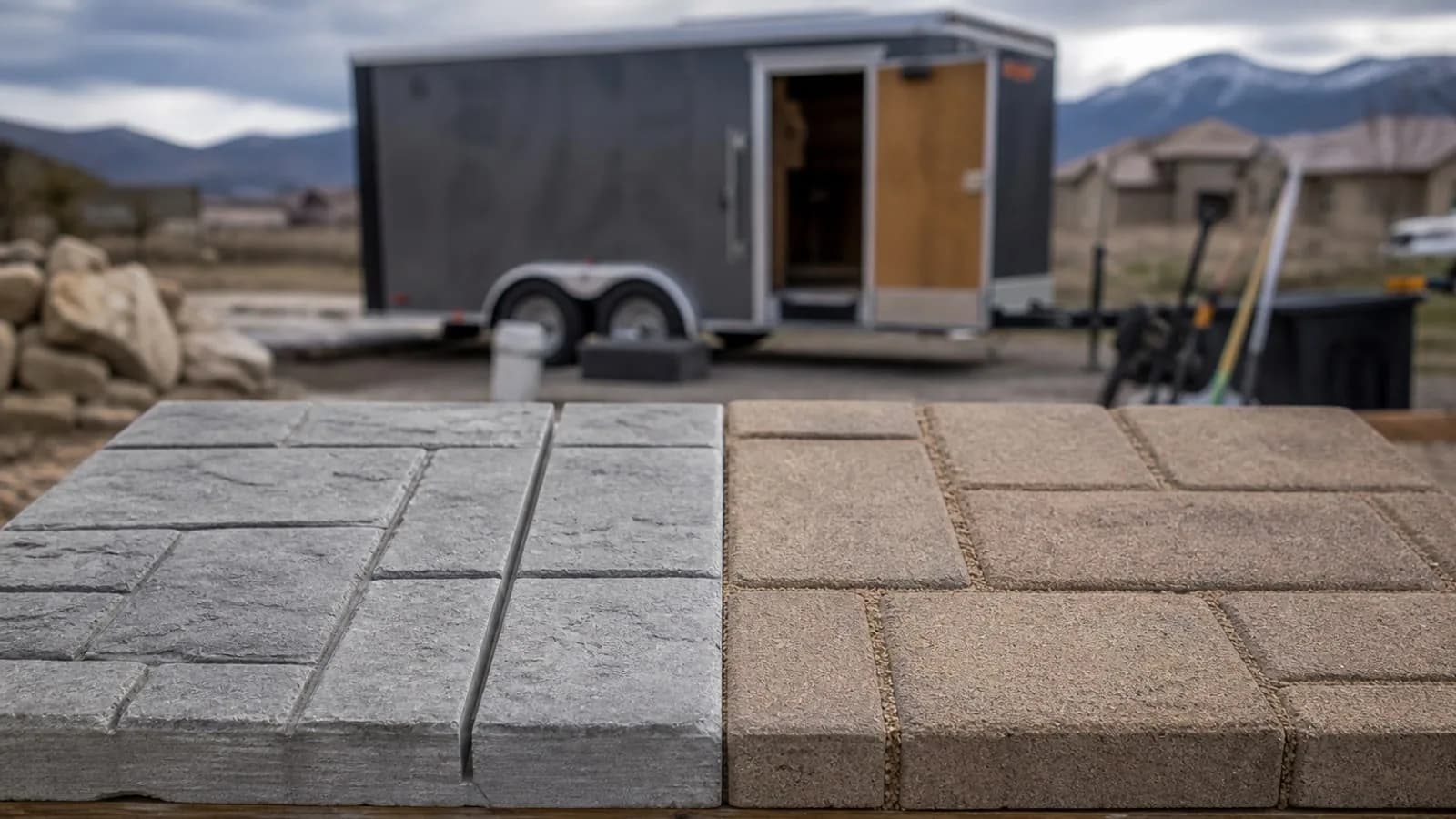
Stamped concrete is poured concrete that has been textured and colored to mimic the look of pavers, flagstone, slate, or other materials. The concrete is poured as a single monolithic slab, stamped while wet, then stained and sealed.
Done well, it looks great on day one. The issue is what happens over the next five to ten years.
What Are Pavers?
Concrete pavers are individual units manufactured to precise dimensions, typically 2.375 to 3.125 inches thick, installed on a compacted aggregate base with sand bedding. They interlock and flex as a system, each unit moving slightly and independently in response to ground movement and freeze-thaw cycles.
The Core Issue: Colorado's Freeze-Thaw Climate
This is where the comparison gets real. Colorado averages over 150 freeze-thaw cycles per year along the Front Range. Every time water infiltrates a material and freezes, it expands. In a monolithic concrete slab, that expansion has nowhere to go except into cracks.
Stamped concrete cracks. Not if, when. Most stamped concrete installations in Colorado show visible cracking within three to seven years. Control joints are cut into slabs to try to guide where cracking happens, but they do not prevent cracking, and they often show up in the middle of a stamped pattern in an aesthetically damaging way. Once cracked, stamped concrete is difficult to repair in a way that is not visible.
Pavers do not crack because they are not a monolithic surface. They flex with the ground. A small amount of settling can be corrected by lifting and releveling individual units. The surface integrity is maintained.
Cost: The Real Numbers
Stamped concrete typically runs $12 to $22 per square foot installed in our market, depending on pattern complexity and coloring. Pavers typically run $15 to $35 per square foot depending on the paver selected and design complexity.
Pavers cost more upfront. But factor in the cost of resealing stamped concrete every two to three years ($500 to $1,500 per application), and the cost of repairs or full replacement when cracking becomes severe, and the total cost of ownership over ten years often favors pavers.
Maintenance: What You Actually Have to Do
Stamped concrete requires periodic resealing to maintain its color and surface protection. In Colorado's UV-intense climate, the sealer breaks down faster than in lower-elevation markets. Skipping resealing leads to fading, surface degradation, and increased cracking. Budget for resealing every two to three years.
Pavers require minimal ongoing maintenance. Sweeping, occasional rinsing, and reapplying polymeric joint sand every five to ten years covers it. Weeds are sometimes an issue in neglected joints, but quality polymeric sand prevents most of it. If a paver stains badly, you can replace individual units.
Repairability
This is one of the most underappreciated differences. Pavers are essentially infinitely repairable. If you need to access a water line, a drainage pipe, or an electrical conduit under your patio, pavers can be lifted, the work done, and the same pavers reinstalled. With stamped concrete, you are jackhammering and patching, and the patch will never match.
Similarly, if a paver section settles, we lift it, add material to the base, and relay. If stamped concrete settles, you get a crack and a trip hazard.
Aesthetics: Honest Assessment
Stamped concrete can look beautiful when it is new and freshly sealed. The seamless look of certain stamped patterns has a clean, finished quality that some homeowners prefer. Over time, however, fading and cracking change that assessment significantly.
Pavers age gracefully. The slight variation in individual units, the natural joints, the texture, all of it holds up and often looks better with time as the installation settles into the landscape.
Our Recommendation
For Colorado's climate, we recommend pavers for most residential patio, driveway, and pool deck applications. The combination of freeze-thaw performance, repairability, and long-term durability gives homeowners a better product over the life of the installation.
Stamped concrete can make sense in specific applications, particularly covered areas that are protected from direct moisture and UV exposure, or in situations where budget constraints make the lower upfront cost necessary.
We install both. If you want to talk through which is right for your specific project, contact us to schedule a design consultation. We will give you a straight answer based on your site conditions, your design goals, and your budget.
Frequently Asked Questions
Do pavers or stamped concrete last longer in Colorado? Properly installed pavers usually outperform stamped concrete in Colorado freeze-thaw because individual units flex instead of cracking as a monolithic slab does. Stamped concrete often shows cracks within a few years.
Is stamped concrete cheaper than pavers? Upfront, stamped concrete often costs less per square foot. Over ten years, resealing and crack repairs on stamped concrete can narrow or erase that gap compared to lower-maintenance pavers.
Which patio surface is easier to repair in Colorado? Pavers. You can lift a section, fix drainage or utilities, and relay the same units. Stamped concrete repairs are visible patches and rarely match texture or color.
Also worth reading: Why some paver installations fail, how much a paver patio costs in Colorado, and our paver installation services.